Articles / Guidesupdated for DaVinci Resolve 21 (September 2026)
Artlist for Freelance Video Editors: Is It Worth It?
Quick answer
Artlist is a strong fit for freelance video editors who regularly need music, sound effects, footage, and templates for client work. Choose a Pro-level license, publish projects while the subscription is active, and confirm template compatibility. Choose an audio-first or per-project service if you only need occasional music and SFX.

You can lose a client project over one line in a license, not one missing cut. We built and run a 100,000+ member professional editing community, and after 7+ years of commercial video work, we judge asset subscriptions by the delivery rules first. As of September 2026, DaVinci Resolve 21 is the host application in this guide.
For the wider product picture, see our Artlist review for DaVinci Resolve editors and our Artlist client-work plan guide. This page narrows the question to freelance buying decisions.
Is Artlist for freelance video editors worth paying for in 2026?
Artlist is worth paying for when your freelance work needs several asset types on a recurring basis and your clients need commercial coverage. It is not automatically the best choice for a music-only editor, a one-off project, or a freelancer who rarely uses stock footage and templates.
The important distinction is between the editing application and the assets inside it. DaVinci Resolve 21 is available in a free edition and a Studio edition. Blackmagic Design lists the free version as supporting 8-bit formats up to 60 frames per second at Ultra HD 3840 x 2160, while Studio adds support for 10-bit video up to 120 frames per second and resolutions beyond 4K. Artlist supplies media and templates. It does not replace Resolve.
Grant Petty, CEO of Blackmagic Design, writes in the official Resolve 21 New Features Guide: “DaVinci Resolve is easy to learn, especially if you’re switching from another editor.” The quotation is useful here because the asset decision only matters after you know which Resolve edition and workflow you are supporting.
That makes the buying decision practical rather than tribal. Ask four questions before you subscribe:
- Do I need music and sound effects, or do I also need footage, templates, LUTs, plugins, and AI tools?
- Am I publishing on my own channel, or am I delivering work for a client to publish?
- Will I finish and publish the project while my subscription is active?
- Will a template work in my edition and version of DaVinci Resolve?
If you answer yes to recurring demand, client delivery, and several asset types, Artlist belongs on your shortlist. If you answer no to two or more of those questions, compare it with a music-first or per-project option before paying.
Artlist is a production-asset subscription, not a replacement for DaVinci Resolve.
How do I decide whether a freelance project needs Artlist?
A freelance project needs Artlist when the value comes from repeatable access to more than one kind of licensed production asset. The decision should start with the brief, the publishing destination, and the client handoff, not with the size of a stock library.
Use this quick project test:
| Project situation | What you actually need | Sensible starting point |
|---|---|---|
| A personal YouTube channel | Music, SFX, and one personal channel | Social coverage may be enough, if the project stays on your own channel |
| A brand video for a client | Music, SFX, footage, or templates with commercial and client coverage | A Pro-level license, with the client and destination documented |
| A recurring mix of ads, explainers, and social cuts | Several asset types, paid-media coverage, and a repeatable archive | Compare Artlist's broader bundle with an audio-first Pro plan |
| One short film needing one track | A single licensed track for one defined production | Compare a single-track license before buying a subscription |
| A template-heavy editing service | Resolve titles, transitions, intros, and slideshows | Check the template's Resolve version and Studio requirement first |
| A large agency or multi-editor workflow | Seats, client coverage, and organizational rights | Ask for team, business, or enterprise terms rather than sharing one login |
We also separate convenience from quality. We haven't run controlled tests of Artlist's search accuracy, music taste, template quality, or download speed, so this guide evaluates public terms and workflow instead.
Does Artlist cover freelance video editors' client work?
Artlist's Pro license is the relevant starting point for freelance client work because Artlist says it covers projects made for clients, commercial use, paid media, branded content, and publishing across a wider range of platforms. The Social license is for personal content creators and personal channels, so it is the wrong default for a freelancer delivering client work.
Artlist describes a client project as a finished project that incorporates its assets into a broader video or production. The client can use the completed project under the license, but the underlying music, footage, SFX, or template isn't a standalone file that the client can take and reuse independently. That difference belongs in your handoff terms.
For example, imagine you edit a product launch video in Resolve 21. You download a music track, two sound effects, a stock clip, and a title template. You deliver the completed video to the client. The client can publish that project when the license covers the use, but you shouldn't hand over the raw music file as a new asset library for the next campaign.
One seat doesn't mean every contractor can browse and download from the account. Decide who downloads assets, keeps certificates, and owns the publishing step.
The current Artlist license guidance also describes reasonable daily download limits of up to 40 songs, 100 sound effects, 40 templates, and 100 clips, footage, animations, or 3D assets. Those limits are not a promise of unlimited automated harvesting. They are a useful reminder that a freelancer should download for real projects and keep a simple asset log.
For freelance client work, the license tier matters more than the number of assets you can browse.
Before you accept a job, write down these five items:
- Client legal name and the person or company publishing the work.
- Platforms and media, including social, websites, paid ads, broadcast, or film festivals.
- Whether the client will need to clear a YouTube upload themselves.
- The subscription status and publication date for the finished project.
- Which files are delivered as a finished project and which remain your licensed production materials.
That list won't replace legal advice or a contract. It will stop a common operational mistake: treating a personal creator license as if it were a blanket agency license.
What happens to an Artlist project after cancellation?
An Artlist stock-asset project remains covered after cancellation only when you completed and published it while the subscription was active. Downloaded stock assets cannot be used in a new project or in a project first published after the subscription expires.
This rule changes how a freelancer should plan cancellation. A video published on the client's website during the active month can remain in use after expiry. A finished timeline that waits in your archive until next quarter to publish has a different licensing problem.
The word published does real work here. A private draft, a local export, or a project waiting for a client approval isn't the same thing as a completed project published during an active term. Don't cancel before you know the client's actual release date.
A client may ask for a new cut six months later. If that cut becomes a newly published project, don't assume the old publication covers it. Check the current terms before promising the re-edit.
Keep a small archive for each job:
| Record | Why it matters |
|---|---|
| Asset name and download date | Shows which subscription period supplied the asset |
| Client and project name | Connects the asset to one finished production |
| License certificate or account record | Gives you evidence if a client asks what was licensed |
| First publication URL and date | Helps establish that publication happened during an active term |
| Final exported filename | Separates the covered project from raw source materials |
This is faster than reconstructing a rights history after a client receives a claim or asks for a re-edit.
A freelance editor should treat cancellation as a publication deadline, not a download deadline.
Why is my Artlist music triggering a "copyright claim" on YouTube?
An Artlist track can trigger an automated YouTube claim when the channel or video is not registered in Artlist's Clearlist, even when the track was downloaded under a valid subscription. Clearlist connects the licensed use to the publishing destination so the platform can recognize it.
Artlist says the Pro plan can Clearlist up to 3 channels per platform, while Team plans can add 5 channels per platform. Artlist also documents client invite links for Pro, Team, and Business plans. Those invite links are valid for 30 days, so a freelancer shouldn't generate one and send it months before the client uploads.
For a client YouTube video, use this workflow:
- Confirm that the plan includes the appropriate Pro-level coverage.
- Open the Clearlist area in the Artlist account.
- Add your own channel or use the client-video option when the client will publish.
- Generate the invite link after you have the final YouTube URL or the client is ready to use it.
- Save the URL, project name, and date in your project archive.
- If a claim appears, follow the platform and Artlist resolution steps instead of deleting the video or replacing the track immediately.
The Clearlist isn't a magic shield. It is a registration step inside a larger license workflow. Check the exact plan, destination, and publication date. A claim can still come from a wrong URL, an unregistered channel, a third-party upload, or a use the selected license doesn't cover.
The common mistake is to deliver the export and assume the freelancer's account automatically covers the client's YouTube channel. Agree who will clear the video and respond if YouTube flags it.
How do I use Artlist templates in DaVinci Resolve 21?
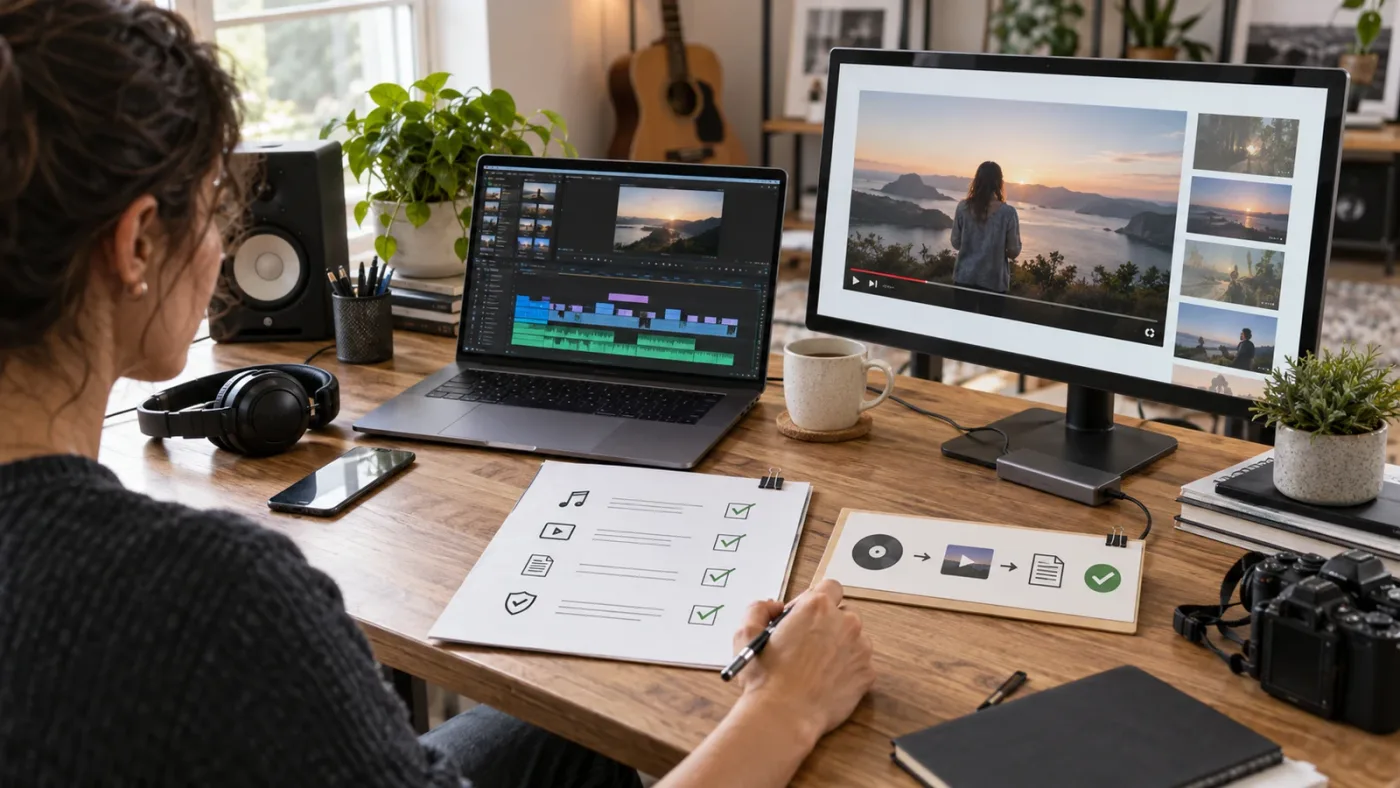
Artlist's documented Resolve template workflow starts with DaVinci Resolve 18 or newer, so DaVinci Resolve 21 meets the baseline. Individual templates can still require Resolve Studio, particular fonts, or a specific version, and Artlist's package normally includes a .dra project archive, a font folder, and a help folder.
Use the template in a test project before placing it in paid client work:
- Open the template page and filter for DaVinci Resolve.
- Read the listed Resolve version and whether the asset requires Studio.
- Download the package and inspect the font and help folders.
- Install required fonts according to your operating system's normal process.
- In the Resolve Project Manager, choose
Restore Project Archive...and select the.draarchive. - Open the restored project and replace the example media.
- Check the title, transition, frame rate, render, and playback behavior in the version of Resolve you will use for delivery.
The free edition is the trap here. A template may rely on Studio-only effects or features. Artlist tells Free users to avoid templates intended for Studio. "Resolve-compatible" doesn't mean every effect inside the project works in every edition.
Missing fonts can break a title. Version mismatch can create missing media, disconnected Fusion nodes, or slow playback. Test the exact asset on the exact machine and edition before the client sees it.
Template compatibility is a bid question. If you quote a fixed price, include time for restoration, fonts, relinking, and a fallback design. A template is a starting point, not a guarantee that the brief fits the example project.
Which Artlist plan should a freelance video editor choose?
Choose the narrowest Artlist plan that covers your asset mix and the client's publishing use, then move up only when a real job requires more scope. Music and SFX Pro is the logical audio-first Artlist starting point; Footage and Templates has the Pro license for client work and adds footage, templates, and LUT access; Max combines broader stock access with Artlist's AI tools.
Artlist's current plan structure separates stock scope from AI scope. The exact price, billing option, tax, credits, and available features can change, so check the live plan page at the time you buy. Don't choose Max because it sounds complete if your freelance work only needs two music tracks each month.
Use this decision matrix:
| If your work looks like this | Consider first | Why | Watch out for |
|---|---|---|---|
| Music and SFX for client videos | Music and SFX Pro | Client, commercial, advertising, and broader platform coverage are the relevant features | Standalone audio use is not the same as syncing music into a finished project |
| Stock footage and motion graphics | Footage and Templates | It includes footage, customizable templates, and a Pro license for client projects | Resolve templates can require Studio or a specific version |
| Frequent work across music, SFX, footage, and templates | Max | It is designed as the combined stock and AI option | More scope doesn't remove the need to verify each license and asset |
| Multiple editors or an agency workflow | Team, Business, or Enterprise | Seat count and organizational coverage may matter more than catalog breadth | One individual login is not a team license |
| Personal content only | Social | A single personal channel per platform may be enough | It does not cover the normal client and paid-media use case |
Map one real client brief to one plan before subscribing. If it passes, ask whether it also fits the next three projects. If it passes only because you might use every feature eventually, wait.
The best Artlist plan is the smallest plan that matches the client's destination and your asset mix.
There is also a timing choice. Annual billing may make sense for an editor with a steady pipeline. Monthly billing may make more sense when your workload is seasonal or you are testing whether clients actually request stock-heavy work. The public plan page shows multiple plan families and billing choices, but it also warns that taxes and plan details vary. Treat the checkout page as the final source for current terms.
Is Artlist better than Epidemic Sound, Envato Elements, or Storyblocks?
Artlist is better when a freelancer wants one broad production-asset subscription, while the alternatives win when the work is primarily audio, design assets, or footage at scale. The right comparison is about license shape and asset mix, not a vague claim that one catalog is best.
| Service | Where it fits a freelance Resolve workflow | Where it wins over Artlist | Main trade-off |
|---|---|---|---|
| Artlist | Music, SFX, footage, templates, LUTs, plugins, and optional AI tools | A broad bundle for editors who repeatedly need multiple asset types | You must choose the right license, publish stock projects while active, and check template compatibility |
| Epidemic Sound | Audio-led editing with music, SFX, stems, and freelancer-focused plans | It publicly describes more than 55,000 tracks, more than 250,000 sound effects and variations, plus a single-track license that covers up to 10 published links | It is primarily a soundtracking choice, so footage and template needs may require another vendor |
| Envato Elements | Mixed creative work needing templates, footage, graphics, photos, fonts, and other design assets | Its license uses one specified project per item and can become perpetual for that completed end product after an active subscription | Reusing the same item across separate projects requires a new license for each project |
| Storyblocks | Footage-led work with templates, images, audio, and AI tools | Its current individual plans advertise unlimited downloads and 8K, 4K, and HD footage, with an all-access tier that includes music and SFX | Individual, small-business, and business rights differ, so client coverage needs its own check |
Epidemic Sound is the cleanest alternative when your real job is soundtracking. Its official plan guidance says the Pro plan is designed for professionals and freelancers, covers online platforms and digital ads, and supports three channels per platform. Its support documentation lists a single-track license for up to 10 published links. That can beat a full subscription when a client needs one defined track for one production.
Envato Elements is attractive when your client work crosses video, graphic design, fonts, presentations, and other creative deliverables. Its license says each download creates a commercial license for one specified use, and a new project requires a new license. That differs from Artlist's subscription-period rule. Neither model is universally better. Match the model to how often you reuse the same asset.
Storyblocks is a strong footage-led comparison. Its current pricing page lists unlimited downloads, 8K, 4K and HD footage, video templates, and, on its higher individual tier, music and sound effects. Its business documentation is separate from its individual plan, which matters if you are an agency or if the client needs broad organizational rights.
Our Epidemic Sound vs Artlist guide goes deeper on the audio-first choice.
If you mainly cut talking-head videos and need a reliable music bed, start with an audio-first option. If you deliver ads, explainers, and social packages that mix stock footage, titles, and sound, Artlist's bundle may reduce vendor switching. If the same template appears in many unrelated client projects, read the license carefully before assuming a subscription makes that reuse acceptable.
What common mistakes should freelance video editors avoid?
The expensive mistakes are predictable: choosing Social for client work, publishing after cancellation, handing over raw assets, skipping Clearlist, and restoring a template without checking the Resolve edition. Each mistake begins as a workflow shortcut and ends as a rights question.
Here are the checks we would put in a freelance project template:
- Don't call royalty-free the same as unrestricted. A royalty-free or subscription license still has a scope, a user, a use case, and a destination.
- Don't treat a download as ownership. Artlist licenses use of an integrated asset in a broader project. The raw track, clip, or template isn't yours to redistribute as a standalone library.
- Don't use Social for a client channel. Personal-channel coverage and client delivery are different cases.
- Don't cancel before publication. A finished edit waiting for a client launch can fall outside the active-subscription rule.
- Don't promise that every Resolve template works in Resolve Free. Check Studio requirements, fonts, version, and Fusion dependencies.
- Don't let the client discover a YouTube claim first. Agree who will Clearlist the channel or video and who owns the response.
- Don't share one personal seat with a rotating team. If several people need access, ask about team or business coverage.
- Don't build a bid around an unverified catalog count or a temporary price. Plan pages change, and regional taxes can change the checkout total.
The simplest safeguard is a rights note inside the same folder as the Resolve project. Put the client, plan, asset names, publication date, destination URLs, and delivery boundary in it. Five minutes at project close beats an uncertain answer six months later.
Should you buy Artlist for freelance video editing?
Buy Artlist if you regularly deliver client videos that combine music, SFX, footage, and motion graphics, and you are willing to manage the Pro-level license and publication timing. Choose Epidemic Sound when your work is mostly audio, Envato Elements when your clients need a wider design library with project-by-project licensing, or Storyblocks when footage volume is the main requirement.
Our practical recommendation is to test one real client brief, not a hypothetical future business. List the assets, the publishing destination, the client relationship, the Resolve edition, and the planned publication date. Then compare the plan that covers that brief with one audio-first and one per-project alternative.
If you do choose Artlist, use the current plan page and license terms at checkout, keep the asset record, test every Resolve template in your delivery environment, and publish covered stock projects while the subscription is active.
Affiliate disclosure: If you subscribe through Artlist's current plan options, we may earn a commission at no extra cost to you. That relationship doesn't change the licensing verdict.
The verdict is simple: Artlist fits a busy, multi-asset freelance editor. It is a poor choice when you need one song, one project, or one personal channel.
Frequently asked questions
- Is Artlist worth it for freelance video editors?
- Artlist is worth it when you regularly need several asset types and deliver client projects under a Pro-level license. It is a weaker value for occasional music-only work, where a single-track license or audio-first service may fit better.
- What Artlist plan covers freelance client work?
- Choose a plan that includes the Pro license, such as the relevant Pro stock plan or a suitable Max, team, business, or enterprise option. Social licensing is for personal channels and does not cover client projects or paid media.
- Can I use Artlist music after cancelling?
- You can keep using a project that you completed and published while your subscription was active. You cannot use downloaded stock assets in new projects or publish new projects after the subscription expires.
- Why is my Artlist music getting a YouTube copyright claim?
- The video or channel may not be on Artlist's Clearlist. Add the correct channel or video URL, then follow Artlist's claim-resolution process; a legal download alone does not guarantee that YouTube will skip an automated claim.
- Do Artlist templates work in DaVinci Resolve 21 Free?
- Artlist lists DaVinci Resolve 18 or newer as the baseline, so Resolve 21 meets that version requirement. Individual templates can still require Resolve Studio, specific fonts, or other compatibility checks, so filter and read the asset page before downloading.
Sources
- Artlist license guidance for Social and Pro use
- Artlist Clearlist guidance
- Artlist template compatibility and workflow guidance
- Artlist plans and pricing
- DaVinci Resolve 21 official product page
- DaVinci Resolve 21 New Features Guide
- Epidemic Sound plan guidance for freelancers
- Epidemic Sound single-track licensing
- Envato Elements license
- Storyblocks subscription plans
- Storyblocks individual and business licenses
Keep reading
Reviews · Sep 1, 2026 · 8 min
Artlist Review for DaVinci Resolve Editors (2026)
An honest Artlist review for DaVinci Resolve editors covering music, SFX, footage, templates, Resolve 21 compatibility, licensing, and alternatives.

Guides · Aug 30, 2026 · 8 min
Artlist Plan for DaVinci Resolve Client Work: Choose Pro
Choosing an Artlist plan for DaVinci Resolve client work? Compare Social, Pro, Team, Max, licensing, Clearlist, templates, and cancellation rules.
Comparisons · Aug 24, 2026 · 40 min
Epidemic Sound vs Artlist for DaVinci Resolve (2026)
Epidemic Sound vs Artlist for DaVinci Resolve 21: compare plugins, music, SFX, licensing, templates, pricing, and the right plan for your edit.