Articles / Guidesupdated for DaVinci Resolve 21.0 (September 2026)
How to Make a Telephone Voice Effect in DaVinci Resolve
Quick answer
To make a telephone voice effect in DaVinci Resolve 21, open Fairlight, apply the General - Telephone effect EQ preset to the dialogue track, then add light compression and optional distortion. If the preset is missing, recreate it with a narrow band-pass EQ and audition it against the dry voice.
The quickest route is Fairlight’s built-in EQ. I start with the telephone preset, then decide whether the scene needs compression, distortion, or nothing else. After 7+ years of professional commercial editing, I’ve learned that the clean version usually works better than the most damaged version.
As of September 2026, this guide targets the final DaVinci Resolve 21 release, listed by Blackmagic Design on June 3, 2026. Resolve 21 is available as a free edition and a Studio edition, while Fairlight supplies the audio tools used here. (Blackmagic Design support)
What makes a voice sound like a telephone in DaVinci Resolve?
A telephone voice effect is a deliberately narrow version of the original dialogue. EQ removes low and high information, while compression and optional distortion add pressure and roughness.
Blackmagic’s Fairlight training material documents a named General - Telephone effect EQ preset. The Resolve 20 Editor’s Guide describes that preset as limiting the voice to roughly 300 Hz to 3 kHz, with a small reduction around 1 kHz. Treat those numbers as a reference for the preset, not a rule for every voice. (Blackmagic’s Fairlight Audio Guide; Resolve 18 Fairlight Audio Guide)
DaVinci Resolve 21 can create a convincing telephone voice effect with Fairlight’s built-in EQ and dynamics.
Fairlight is a sensible place to build this effect because Blackmagic says every track includes real-time equalization and dynamics processing. Its mixer provides a 6-band parametric EQ, 5 built-in track FX, and 6 real-time track effect inserts. (Blackmagic Design Fairlight)
How do I make a telephone voice effect in DaVinci Resolve 21?
The direct answer is simple: isolate the dialogue, open its Fairlight track EQ, select General - Telephone effect, and audition it against the unprocessed voice. Then add only the extra processing the scene needs.
1. Put the dialogue on its own track
Move the line, voicemail, radio message, or phone conversation to a dedicated audio track. If it shares a track with music or sound effects, the track EQ will affect those sounds too. Keep the original track disabled so you can compare later.
2. Open Fairlight and show the Mixer
Click the Fairlight page, then open the Mixer if it isn’t visible. Find the dialogue channel and look for the small EQ section above the fader. Blackmagic’s Fairlight page says you can double-click that area to open the 6-band parametric equalizer. (Blackmagic Design Fairlight)
3. Choose the telephone EQ preset
Open the preset menu in the Equalizer window and choose General - Telephone effect. Play a sentence on loop. The voice should become thinner and more focused, but the words should remain easy to understand.
The fastest telephone voice effect workflow in DaVinci Resolve is to start with the General - Telephone effect EQ preset.
Use the EQ window’s A/B comparison when it’s available. Listen to the dry and processed voices at a similar loudness.
4. Recreate the effect manually when the preset is missing
If you can’t find the named preset, use the same idea with the parametric EQ:
- Add a high-pass filter and raise its frequency until rumble and chest tone fall away.
- Add a low-pass filter and lower its frequency until hiss and air disappear.
- Keep the remaining band wide enough for consonants to survive.
- Sweep the middle gently and cut any nasal buildup rather than boosting everything.
The manual method gives you control when the preset’s curve doesn’t suit the speaker or recording.
5. Add compression only after the EQ
Open the track’s Dynamics section and add gentle compression. Set the threshold to catch louder words, then stop when the voice sits more evenly. If the line pumps, back off. Compression should support the words rather than announce itself.
Mary Plummer, the named author of Blackmagic Design’s Fairlight Audio Guide, gives the right general rule for this kind of work: “One of the secrets to working with equalization is to make changes in small increments and use multiple processing effects in combination.” (Fairlight Audio Guide)
6. Add distortion for an old or overloaded line
Distortion is optional. Open the Effects Library, find the Fairlight distortion effect if it is present in your installation, and add it to the dialogue clip or track. Start with the lowest useful drive. If the consonants turn into sand, reduce the drive or mix.
Blackmagic says Fairlight FX can be dragged onto a clip or track, and that multiple plug-ins can be reordered. The order matters here: EQ first, compression second, distortion last gives you a cleaner way to judge what each stage contributes. (Blackmagic Design Fairlight)
A telephone voice effect should narrow the voice before distortion is added.
7. Match the effect to the scene
For a clean modern call, stop after EQ and light compression. For an old handset, add a little distortion and quiet line noise. For a failing connection, automate a short burst of grit instead of leaving heavy distortion on every word.
If you need a broader sound-design pass, our guide to mixing audio in DaVinci Resolve with Fairlight covers track processing and level decisions.
How do I make an old phone voice instead of a clean cell phone voice?
To make an old phone voice, keep the narrow EQ, add restrained compression, and introduce a small amount of unevenness with distortion or noise. Don’t begin by destroying the signal. Begin with the frequency shape.
Here’s the decision table I use:
| Target sound | EQ move | Extra processing | Stop when |
|---|---|---|---|
| Clean phone call | Use the telephone preset | Light compression | The voice is narrow but natural |
| Old handset | Narrow the band manually if needed | A touch of distortion and noise | The line feels limited, not fuzzy |
| Overloaded speaker | Keep the telephone EQ | More compression and a little grit | Peaks sound stressed but words remain clear |
| Bad connection | Automate the effect | Short bursts of distortion or level drop | The disruption supports the edit |
The table gives you a direction, not a preset pack. A bass-heavy voice may need more low-end removal, while a thin voice may need a wider band or no distortion.
Light compression adds the controlled density that makes a phone voice stay intelligible.
For a radio-like variation, our guide to making music sound like a radio in DaVinci Resolve uses the same broad idea, but music needs different judgment from dialogue.
Why is my telephone voice effect too muffled or harsh?
Your telephone voice effect is usually too muffled because the EQ has removed too much useful midrange, or too harsh because distortion is doing the work that EQ should do. Bypass one processor at a time and fix the first stage that causes the problem.
If the voice is muffled
Widen the EQ slightly. Raise the low-pass point until consonants return, or reduce the depth of any midrange cut. Compare the processed voice with the dry voice at matched loudness. If you can’t understand the sentence at a normal playback level, the effect has gone too far.
If the voice is harsh
Reduce distortion before changing the EQ. Then listen for a sharp upper-mid bite and soften it with a small cut. Don’t add reverb just to hide harshness. Reverb changes the scene, while the telephone effect should usually stay close and direct.
If the effect disappears in the mix
Raise the processed track only enough to recover intelligibility. Check it with the full mix playing, then automate the level when the call begins and ends.
The same principle applies to remote or off-screen voices. If the phone caller also needs to feel far away, see how to make sound effects sound distant in DaVinci Resolve, but keep the telephone EQ separate from the distance treatment so you can revise either choice.
Can I make a telephone voice effect in the free version of DaVinci Resolve?
Yes, you can start with DaVinci Resolve 21 Free. Blackmagic lists Resolve 21 as a free download and describes Fairlight’s track EQ and dynamics as built-in processing; Studio adds more Fairlight FX and other advanced tools. (Blackmagic Design Fairlight)
If a preset or distortion plug-in isn’t available, use the manual EQ method. The important ingredients are a narrow range, controlled level, and a clear performance.
If you’re learning where Resolve keeps these controls, TryUncle is the on-screen assistant for DaVinci Resolve on macOS, ask in plain words and Uncle points at the exact control on your screen.
How do I finish and check the effect before delivery?
Compare the processed line with the dry line, then listen in context. Keep the original audio available and check the transition into and out of the call.
Use this final pass:
- Bypass EQ, compression, and distortion one at a time.
- Match the processed and dry versions by perceived loudness.
- Listen in the full mix, not only with the dialogue soloed.
- Automate the effect if the call starts or ends inside a shot.
- Keep the effect subtle enough that the audience follows the story.
The best telephone voice effect is the one that survives the full mix, not the one that sounds most damaged in solo.
Resolve 21 gives you enough native Fairlight control to build this effect cleanly. Start with General - Telephone effect, adjust the curve for the speaker, add compression if the level needs control, and stop before the texture buries the line. That’s the whole move.

Frequently asked questions
- How do I make a telephone voice effect in DaVinci Resolve 21?
- Open the Fairlight page, show the Mixer, open the dialogue track's EQ, and choose General - Telephone effect. Add gentle compression, then a small amount of distortion only if the voice needs more grit.
- Why is my telephone voice effect too muffled in DaVinci Resolve?
- The EQ is removing too much of the voice's useful midrange, or the distortion is masking consonants. Bypass each processor, reduce the distortion first, and widen the EQ slightly until words stay clear.
- Can I make a telephone voice effect in the free version of DaVinci Resolve?
- Yes, you can start with the Fairlight track EQ and dynamics in DaVinci Resolve 21 Free. If a named preset or extra Fairlight FX is unavailable, build the effect manually with high-pass and low-pass filtering plus restrained compression.
- How do I make an old phone voice instead of a clean cell phone voice?
- Start with the telephone EQ, then add a little distortion, tighter compression, and very quiet line noise. Keep the texture below the words so the effect suggests an old circuit without turning the dialogue into fuzz.
- Do I need distortion for a telephone voice effect in DaVinci Resolve?
- No. EQ alone creates the recognizable narrow telephone tone. Distortion is optional and should be added only when the scene calls for a damaged, vintage, or overloaded line.
Sources
Keep reading
Guides · Jul 11, 2026 · 31 min
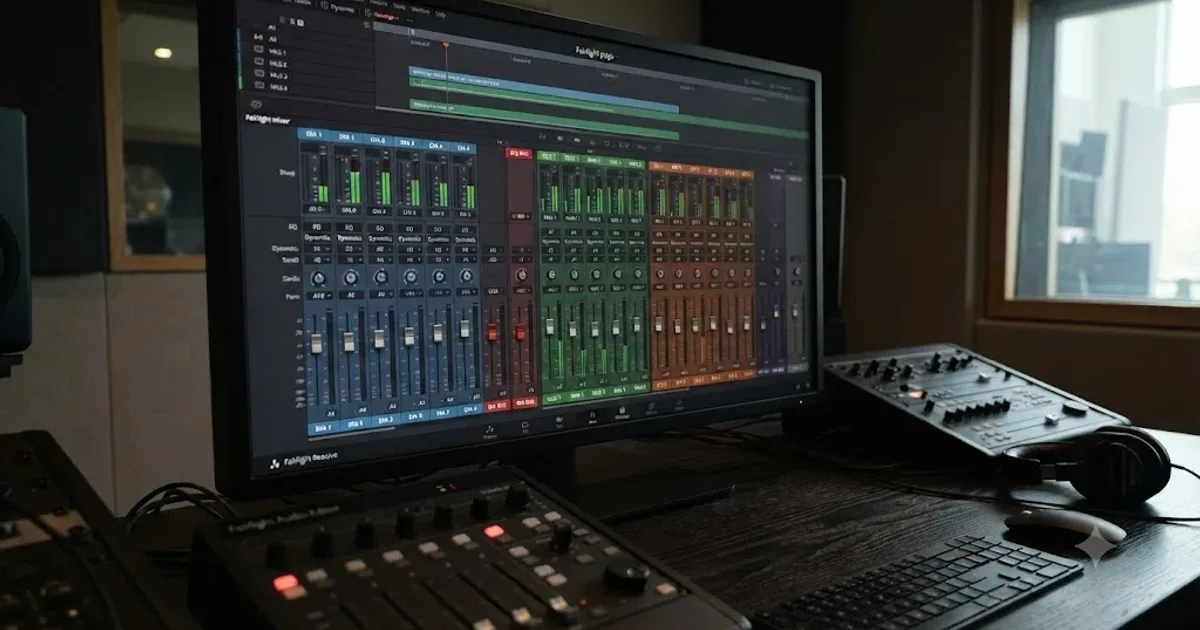
How to Mix Audio in DaVinci Resolve Using Fairlight
Mix audio in DaVinci Resolve's Fairlight page: build a dialogue/music/effects bus structure, gain-stage your clips, EQ and compress dialogue, then duck music under it.
Guides · Sep 6, 2026 · 8 min
How to Make Music Sound Like a Radio in DaVinci Resolve
Make music sound like a radio in DaVinci Resolve 21 with EQ, filtering, light distortion, and automation. Start with these practical settings.
Guides · Sep 1, 2026 · 8 min
DaVinci Resolve: Make Sound Effects Sound Distant
Learn how to make sound effects sound distant in DaVinci Resolve 21 with Fairlight EQ, level, reverb, delay, and automation.